
AI Writing Tools That Won’t Get You Flagged for AI Content: Three Options Compared
If you’re worried about AI detection tools flagging your content, you’re not alone. Writers, marketers, and business owners face a tricky situation: they want the efficiency of AI writing tools but need content that reads naturally and passes detection software. The good news is that not all AI writing solutions are created equal. Some produce generic, easily detected text, while others help you create work that sounds genuinely human. This comparison breaks down three different approaches to AI-assisted writing, examining their strengths, weaknesses, and how they stack up against each other. Whether you prioritize customization, authenticity, or specific use cases, you’ll find practical insights to help you choose the right tool for your needs.
- Legiit: Human-AI Hybrid Services Compared to Pure Software Solutions

Legiit takes a fundamentally different approach than standard AI writing software. Instead of giving you direct access to an AI tool, it connects you with professional writers who use AI as part of their workflow. This means you get content that benefits from AI efficiency but includes the critical human touch that makes writing sound natural and pass detection tests.
The comparison here is interesting. Pure AI software gives you speed and low cost per word, but you’re responsible for editing, refining, and making the content sound human. Legiit‘s marketplace model costs more upfront, but you receive finished content that’s already been reviewed and refined by an actual person. The writer handles the heavy lifting of turning AI drafts into polished, natural-sounding pieces.
One major advantage over standalone tools is accountability. When you hire through Legiit, you’re working with a service provider who has ratings, reviews, and a reputation to maintain. If the content gets flagged or doesn’t meet your standards, you have recourse. With software alone, you’re on your own if the output doesn’t work.
The trade-off is control and turnaround time. Direct AI tools let you generate content instantly at 3 AM if you need it. With Legiit, you’re working with another person’s schedule, which means planning ahead. You also have less control over the exact writing process, though you can communicate your requirements clearly upfront.
For businesses that need reliably human-sounding content without becoming experts in AI prompting and editing, Legiit offers a middle path. You get AI efficiency without the detection risk, though you pay more than you would for a monthly software subscription. It’s particularly valuable for high-stakes content like sales pages, blog posts that need to rank well, or anything where getting flagged could damage your credibility.
- Jasper Versus Copy.ai: Feature Sets and Detection Risk Analysis
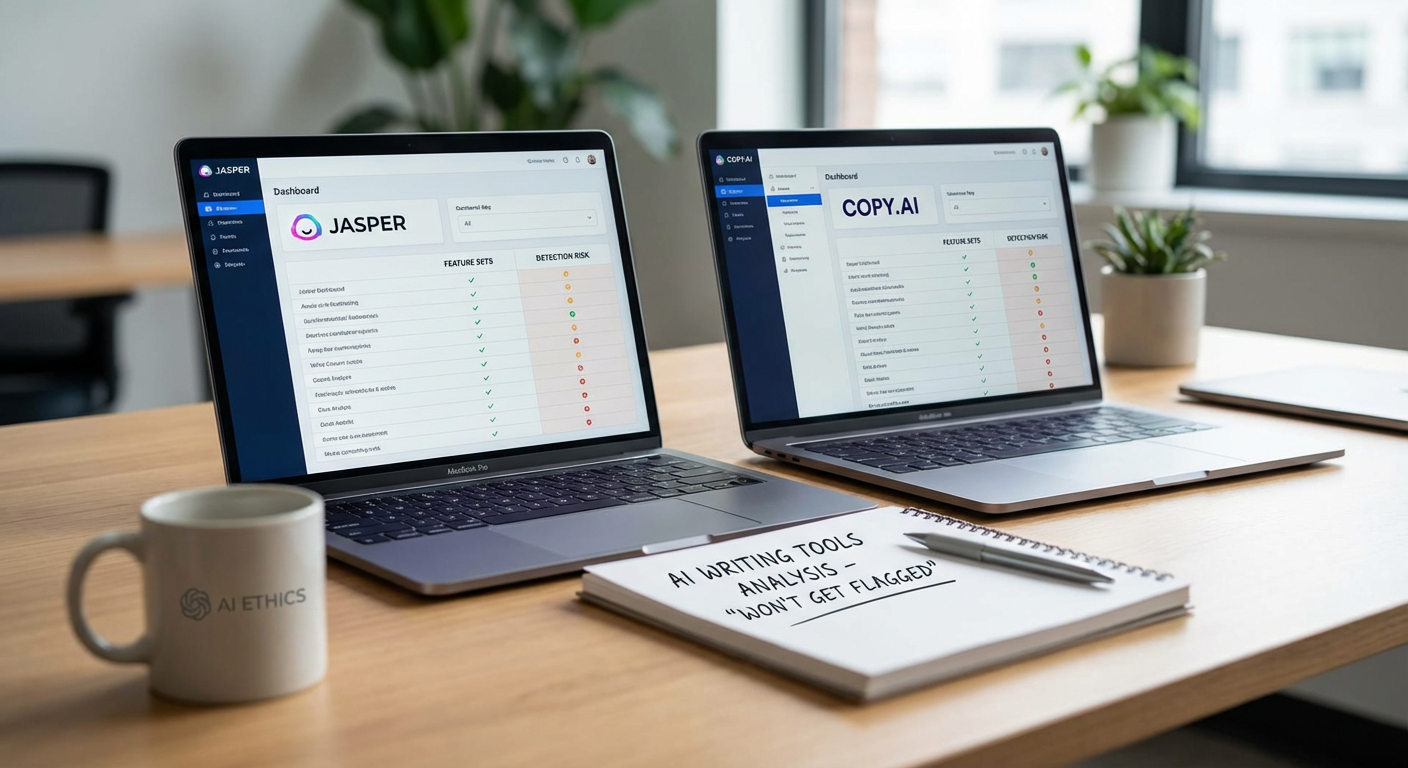
Jasper and Copy.ai represent two of the most popular AI writing platforms, but they handle the detection challenge differently. Understanding how they compare helps you choose based on your specific content needs and risk tolerance.
Jasper positions itself as a more premium option with advanced features. It offers Boss Mode, which gives you more control over longer-form content and includes a built-in editor. The platform has templates for specific content types and lets you set custom brand voices. In terms of detection risk, Jasper’s output tends to be fairly predictable unless you invest significant time in customizing prompts and editing the results. The quality is consistent, but consistency is actually part of what detection tools look for. The advantage is reliability: you know what you’re getting each time.
Copy.ai, by comparison, focuses more on marketing copy and shorter content pieces. It’s generally less expensive and has a simpler interface. The platform excels at generating multiple variations quickly, which is useful for testing different approaches. However, this volume-focused approach can lead to more generic output if you’re not selective. Copy.ai content often needs substantial editing to avoid sounding formulaic. The detection risk is similar to Jasper, maybe slightly higher for generic prompts, but lower cost makes it easier to justify the time spent on revisions.
Where these tools really differ is in workflow integration. Jasper offers more sophisticated features like SEO mode and direct integrations with other platforms, making it better for content teams with established processes. Copy.ai is more accessible for solo users or small teams who need quick wins without a learning curve.
Both tools will produce content that can be flagged if you use them carelessly. The key difference is that Jasper gives you more tools to customize and refine within the platform, while Copy.ai assumes you’ll do most refinement outside the tool. If you have editing skills and time, Copy.ai’s lower price point makes sense. If you want more hand-holding and built-in quality controls, Jasper justifies its higher cost. Neither tool guarantees undetectable content, but both can produce acceptable results when you treat them as starting points rather than finished products.
- Sudowrite Versus Standard Content Tools: Creative Writing Applications Compared
Sudowrite occupies a different niche than general content tools, and this specialization affects both its usefulness and its detection profile. Comparing it to broader tools reveals important trade-offs for specific types of writers.
Sudowrite is built specifically for creative writers working on fiction, scripts, and narrative content. Instead of focusing on blog posts or marketing copy, it offers features like “Describe” for adding sensory details, “Rewrite” for alternative phrasings, and “Brainstorm” for plot ideas. This specialization means the AI is tuned differently than tools trained primarily on marketing content and articles. The output tends to include more varied vocabulary, unexpected word choices, and stylistic flourishes that make it sound less robotic.
Compared to tools like Jasper or Writesonic, Sudowrite produces content that’s harder to detect as AI-generated, particularly for narrative work. The reason is partly technical (different training focus) and partly practical (creative writing has more acceptable variation in style). Detection tools are calibrated mostly on informational content, where they look for patterns common in AI-generated articles. Creative writing with dialogue, varied sentence structures, and descriptive language doesn’t trigger the same red flags as easily.
The major limitation is narrow application. If you need blog posts, product descriptions, or business content, Sudowrite isn’t designed for that work. You could force it to generate informational content, but you’d be working against the tool’s strengths. Standard content tools handle a wider range of writing tasks, making them more versatile even if their output is more easily detected.
Cost comparison also matters. Sudowrite uses a credit system based on words generated, which can get expensive if you’re producing high volumes. Broad-purpose tools typically offer unlimited plans that make more sense for content creators who need dozens of pieces monthly. For novelists or screenwriters producing one project at a time, Sudowrite’s pricing is reasonable. For content marketers, it’s not economical.
The detection angle here is interesting: Sudowrite’s specialized focus makes it better at avoiding flags for its intended use case, but worse as an all-purpose tool. If you’re writing fiction or creative content, it outperforms general tools both in quality and detection avoidance. For any other application, you’re better served by tools built for informational content, even though you’ll need to work harder to make that content sound human. Choose based on what you’re actually writing, not just on detection risk alone.
Choosing an AI writing tool that won’t get flagged isn’t about finding one magic solution. It’s about understanding the trade-offs between different approaches and matching them to your specific needs. Service marketplaces like Legiit offer the most hands-off approach with human oversight built in, though at a higher cost. General content tools like Jasper and Copy.ai provide good value and versatility but require your active involvement in editing and refinement. Specialized tools like Sudowrite excel in narrow applications where their unique training makes detection less likely. The best choice depends on your budget, the type of content you create, your editing skills, and how much risk you can tolerate. Whichever direction you go, remember that AI tools work best as assistants, not replacements. The more you contribute your own voice, structure, and editing, the less likely any detection tool will flag your work.
Recent Comments